
Sustainability Coordinator: driving sustainable POS displays
Key takeaways
• Apolline de Patoul, Sustainability Coordinator at POP Solutions, translates the European Green Deal into practical action across the business.
• Internally, she coordinates and drives POP Solutions’ CSR strategy.
• Externally, she develops eco-design methodologies and provides the environmental data required for client reporting.
• POP Solutions holds EcoVadis Gold certification, placing it among the top 5% of certified companies in its sector, and uses FSC-certified cardboard.
• POP Solutions measures both its own carbon footprint and that of its products upon request.
In the POS display industry, environmental and social performance has become a key selection criterion and is now routinely considered in tender processes. At POP Solutions, Apolline de Patoul, Sustainability Coordinator, monitors the evolving requirements of the European Green Deal and turns them into practical actions. Working across design, procurement, production and sales, she helps build a CSR approach that is reliable, measurable and embraced across the business.
Who is Apolline de Patoul, Sustainability Coordinator at POP Solutions?
Apolline de Patoul is Sustainability Coordinator at POP Solutions. Based in Nivelles, she coordinates the company’s CSR strategy across the group’s five design offices (Amersfoort, Antwerp, Mechelen, Nivelles and Liège) and two production sites (Nivelles and Antwerp).
She is also responsible for securing and maintaining the certifications that demonstrate POP Solutions’ commitment to sustainability, including EcoVadis Gold (renewed in 2025) and FSC. In addition, she supports clients in navigating regulatory requirements and developing more sustainably designed projects.
What does a Sustainability Coordinator do in the POS display industry?
The Sustainability Coordinator’s role spans two complementary areas. Internally, they define, coordinate and drive the company’s CSR strategy. Externally, they develop the methods that integrate eco-design into client projects and provide the environmental data needed for reporting.
Internal responsibilities
Within POP Solutions, Apolline structures the company’s CSR strategy around several coordinated operational initiatives.
These include measuring the carbon footprint of POP Solutions and the wider group, using energy generated by more than 1,000 photovoltaic panels installed at the production sites, and continuously improving waste sorting practices.

The approach also includes supplier engagement initiatives through dedicated webinars and the sharing of a CSR charter. Wherever possible and compatible with client requirements, POP Solutions prioritises local supply chains and European suppliers. The company further reinforces its commitments through recognised certifications such as EcoVadis, which awarded POP Solutions a Gold Medal for the third consecutive year in 2025.
External responsibilities

The process is supported by ongoing awareness and training programmes designed to engage all teams, including sales, design, procurement, production and logistics. It also relies on environmental data aligned with European standards, which can be used for CSRD and EUDR reporting, as well as carbon footprint assessments available on request to support informed decision-making on a project-by-project basis.
How does eco-design take shape in POS display projects?
Eco-design means developing a POS display in a way that reduces its environmental impact throughout its entire lifecycle, from material selection through to recycling and recovery.
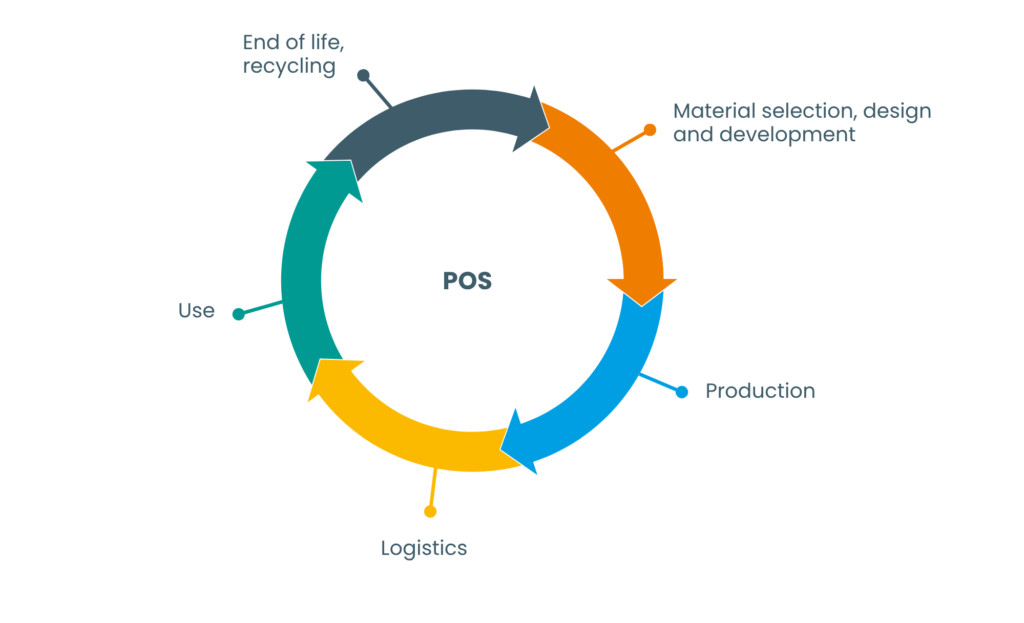
The POS display lifecycle according to POP Solutions
- Material selection and design: FSC-certified cardboard, recycled materials, alternatives to virgin plastic, simplified assembly methods and modular design.
- Production: optimised cutting layouts, reduced material waste and photovoltaic energy at the production sites in Nivelles and Antwerp.
- Logistics: transport optimisation, consolidated shipping flows and carefully considered packaging solutions.
- Use: lifespan aligned with campaign requirements, durability and opportunities for reuse.
- End of life: recyclability, modularity and established recovery channels.
Carbon footprint assessment
To complement this approach, POP Solutions also offers carbon footprint assessments for its POS displays on request. This helps quantify the impact of eco-design decisions and provides brands with reliable data for CSR reporting.
Why is sustainability a collective effort at POP Solutions?
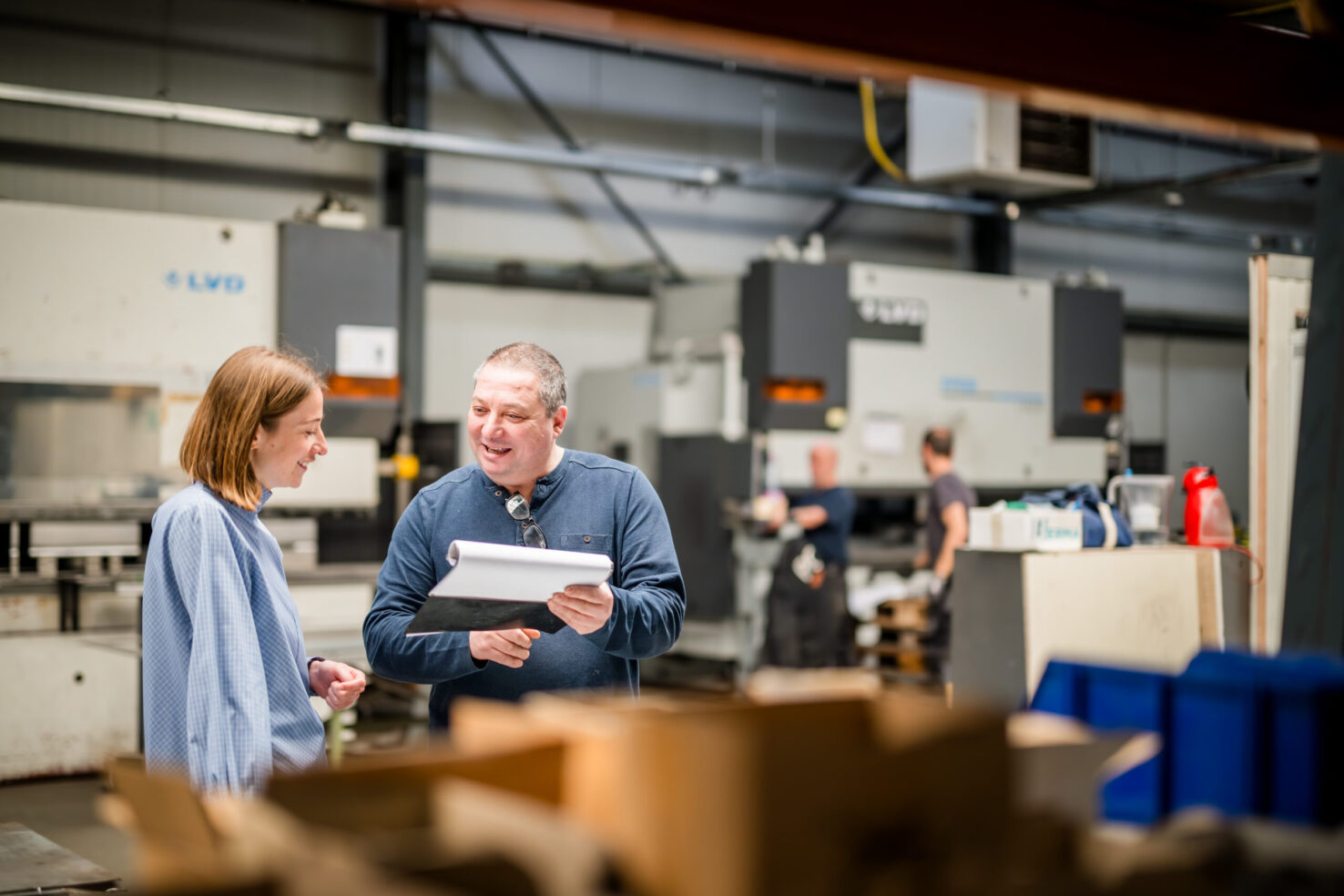
Sustainability is everyone’s responsibility. My role is to set the direction and keep things moving.
The teams involved
Eco-design involves every department within POP Solutions:
- Sales teams: integrating CSR considerations from the initial briefing stage.
- Industrial designers: creating POS displays that use materials efficiently and are easy to dismantle, adapt and reuse.
- Procurement managers: selecting certified and traceable raw materials.
- Production teams: applying eco-design standards throughout manufacturing operations.
- Logistics teams: optimising transport and packaging choices.
An ongoing dialogue with clients and suppliers
Apolline also works directly with clients to answer questions relating to materials, certifications and CO₂ data. At the same time, she collaborates closely with suppliers to ensure that the commitments set out in the CSR charter are upheld throughout the supply chain.
What does this mean in practice for your POS display projects?
Apolline’s support delivers three tangible benefits for brands.
- More sustainable POS displays. Eco-design principles are integrated from the briefing stage and applied throughout the entire lifecycle. Material, design and production choices are assessed upfront with the relevant teams.
- Meeting CSR requirements. POP Solutions’ EcoVadis Gold certification, which places the company among the top 5% of businesses assessed in its sector, demonstrates the strength and credibility of its CSR approach.
- Reliable data for your CSR reporting. POP Solutions measures both its own carbon footprint and that of its products using a recognised methodology, ensuring that your reports are supported by robust and verifiable data.
This gradual, project-by-project approach helps reduce the environmental impact of POS displays while providing meaningful reporting data.
Is it possible to create a POS display with zero environmental impact?
No. No POS display can claim to have zero environmental impact. Sustainability is an ongoing journey built in partnership with brands. Every project involves balancing commercial objectives, technical constraints, usage requirements and environmental considerations.
The choice between cardboard and more permanent materials depends primarily on how the display will be used: its expected lifespan, in-store location and potential for reuse. This is one of the core principles of eco-design at POP Solutions: designing products around their real-world use in order to select the most appropriate material.
The installation of beehives on site reflects this mindset, demonstrating a commitment that goes beyond regulatory compliance and focuses on long-term impact.
Integrate eco-design into your next POS display projects
Would you like to incorporate eco-design into your POS display projects in a practical and credible way? The POP Solutions team can support you from the initial brief through to carbon footprint assessment of your displays. Contact usto start your project or explore our sustainability approach in more detail.