
7 strategies to optimise your in-store POS display placement
Key takeaways
• An effective POS display placement strategy starts with understanding the customer journey.
• The display format (floor display stand, counter display, shelf talker, totem) should support a specific commercial objective.
• A bespoke POS display designed for a targeted retail area performs better than a standardised solution.
• Retail activation finds in POS displays a long-lasting driver of in-store visibility.
The placement of a POS display determines your brand’s visibility and influences purchasing decisions in store. A well-designed display that is poorly positioned will go unnoticed; placed in the right location, it drives sales. Here are seven practical strategies for marketing and sales teams, from assessing the retail environment to avoiding common mistakes.
In-store POS displays: definition and role in commercial performance
In-store POS displays include all communication supports installed at the point of sale to highlight a product, an offer or a brand. Their role is simple: capture shoppers’ attention and guide them through to purchase.
Point-of-sale advertising: the different display solutions
POS signage, counter displays, floor display stands, shelf dressing and shelf signage all form part of point-of-sale advertising. However, the quality of the display alone is not enough: the same POS display may perform exceptionally well on an end cap yet go completely unnoticed in a secondary aisle. Location is what determines visibility.
Why a POS display placement strategy makes all the difference on shelf
Planning your POS display placement from the outset significantly improves performance. A structured strategy helps you:
- attract customers from the moment they enter the store and guide them towards targeted products;
- increase interest in an offer, a new product or a promotional event;
- support in-store sales teams;
- strengthen long-term brand awareness;
- deliver successful retail activations during key trading periods.
POS displays: a key driver of your in-store retail activation
POS displays provide the physical foundation for every retail activation: an event display stand for a product launch, a shelf talker for a promotion, a totem for a seasonal campaign. POP Solutions designs and manufactures these supports, while in-store teams bring campaigns to life on the shop floor. For retail networks, they make it possible to activate multiple points of sale simultaneously.
Let’s explore the seven key strategies.
Strategy 1: identify the hot and cold zones in your store
Hot zones (store entrance, main aisle, end caps, checkout areas) generate the highest levels of footfall, while cold zones (the back of the store and secondary aisles) receive significantly less traffic. Three criteria define each area: customer traffic, eye-level visibility, proximity to the featured product. Including this mapping in the project brief helps determine the most appropriate display format.
Strategy 2: align POS display placement with the customer journey
Each stage of the customer journey requires a different display solution: a totem at the entrance to announce a campaign, a shelf talker to interrupt the customer’s path along the shelf, or a checkout display stand to encourage impulse purchases. The objective is to create one seamless customer experience rather than a series of disconnected marketing actions.
Strategy 3: choose the right POS display format for your objective
Each display format serves a specific objective and location:
- Floor display stands (in cardboard or multiple materials) are ideally positioned on end caps or in main aisles to create high-impact product displays.
- Checkout display stands encourage impulse purchases at the till.
- Totems and pallet dressing increase the visibility of promotional campaigns from the store entrance or along major aisles.
- Shelf dressing solutions (shelf talkers, wobblers, shelf label holders, hanging banners, etc.) attract attention on the shelf, guide shoppers and strengthen brand presence.
- Window stickers capture attention from outside the store and announce the campaign before customers even step inside.
Strategy 4: design bespoke POS displays that support your brand
A bespoke POS display is designed to integrate perfectly into its retail environment while showcasing your brand. Whether intended for a shelf, shop window, end cap or checkout area, it must be tailored to the dimensions and constraints of its location. This level of customisation includes selecting the right material (cardboard, metal, wood, plastic or vinyl for printed elements), designing a modular structure and ensuring full compliance with your brand guidelines.
Strategy 5: ensure successful POS display installation and brief in-store teams
A POS display that is difficult to assemble often ends up unused. POP Solutions supplies the display together with all assembly components; briefing store teams remains the responsibility of the brand and the retailer. To facilitate rollout, we recommend providing: clear assembly instructions, a reference photograph of the desired installation, a follow-up check a few days after installation to confirm correct implementation.
Strategy 6: avoid the most common POS display placement mistakes
Five common mistakes regularly reduce campaign performance:
- choosing a display format that is unsuitable for the available space: too large and it becomes an obstacle; too small and it goes unnoticed;
- overcrowding the shelf with too many displays that compete for attention;
- overlooking eye-level positioning, despite this remaining the most effective viewing zone;
- failing to brief in-store teams, compromising compliance with the merchandising plan;
- underestimating replacement frequency: worn displays damage brand perception.
Strategy 7: learn from successful POS display placement examples
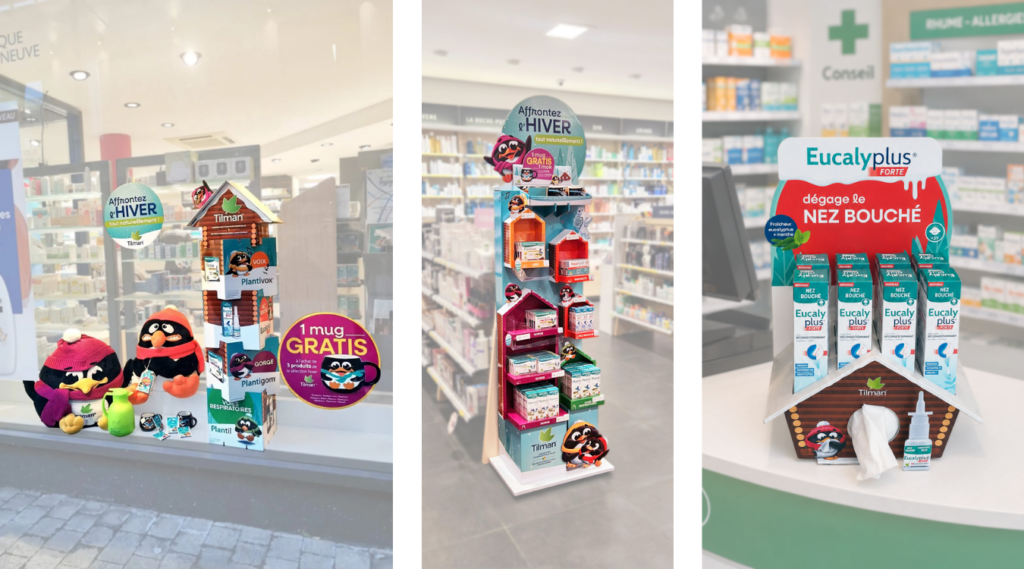
The most successful POS display installations share three common characteristics: bespoke displays adapted to the retail environment, a customer journey planned from the outset and rigorous execution. The Tilman POS display kit is an excellent example: a coordinated solution deployed across several customer touchpoints (floor display stand, checkout display stand and window graphics). Similarly, the Moët & Chandon shelf dressing project transforms standard shelving into a fully branded retail space.
Frequently asked questions
What is the difference between permanent and temporary POS displays?
Temporary POS displays, typically manufactured from FSC-certified cardboard, support short-term campaigns lasting a few weeks. Permanent POS displays, made from metal, plastic or wood, remain in place for several months or years and reinforce a premium brand image. The right choice depends on campaign duration, budget and the retail environment.
How do you measure the effectiveness of in-store POS display placement?
Performance is measured through shopper stop rate, sales growth for the featured product and the lifespan of the display itself. Comparing results across different locations helps optimise future campaigns.
How far in advance should POS displays be ordered for an event?
Cardboard POS displays generally require only a few weeks after prototype approval. Permanent or multi-material display solutions require longer lead times. Planning your project early ensures delivery in time for your key commercial campaigns.
Optimise your POS display placement with POP Solutions
Successful POS display placement combines strategic planning, the right display format and flawless execution. POP Solutions supports you as a single partner, from bespoke design and manufacturing through to delivery. EcoVadis Gold certified (placing us among the top 5% of certified companies in our sector), we design POS displays in FSC-certified cardboard, metal and wood.
We also design and manufacture bespoke permanent display stands and retail furniture. Feel free to contact us to find out more.